
Land of Five Rivers: Punjab's vibrant history, geography, and culture, capturing ancient civilization and lush landscapes
Welcome to the Land of Five Rivers, where history flows as endlessly as the Jhelum, Chenab, Ravi, Beas, and Sutlej. Punjab's 5,500-year-old legacy stretches from the ancient Indus Valley Civilization to the golden Sikh Empire of Maharaja Ranjit Singh. Every village, festival, and folk song carries the soul of a civilization built on courage, spirituality, and hospitality. From the thunder of Bhangra to the serenity of the Golden Temple, Punjab's culture is vibrant and alive. Join us in celebrating Punjab's extraordinary heritage — its stories, rivers, traditions, and timeless people that continue to inspire the world.


Discover Punjab — 5,500 Years of Living Heritage
Explore
Delving into Punjab’s rich history, culture, and natural beauty.
History
Punjab's 5,500-Year Historical Journey
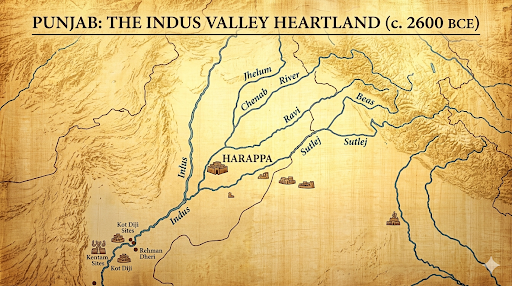
From the ancient Harappan settlements along the Indus to the grandeur of the Sikh Empire, Punjab's timeline is extraordinary. This land witnessed Vedic sages, Alexander's eastward march, Mauryan rule, and Mughal dominance before Maharaja Ranjit Singh united the region into a powerful sovereign state in the 19th century. British colonialism and the traumatic Partition of 1947 redrew borders but never broke Punjab's spirit. Today, modern Indian Punjab stands as the nation's agricultural backbone — a civilization continuously shaped by conquest, faith, revolution, and an unrelenting will to rebuild, survive, and flourish across every era. Punjab's histor— it is a living, breathing legacy
Culture
The Bold Living Culture of Punjab
The 3,000-year cultural evolution of Punjab is a resilient saga of synthesis, where the Vedic hymns of the Sapta-Sindhu met the mystic echoes of Sufi dervishes and the revolutionary sovereignty of the Sikh Gurus. This land, defined by its five perennial arteries, transformed from an ancient urban cradle into a martial and agrarian powerhouse. Every fold of Phulkari, every beat of the Dhol, and the communal grace of Langar reflects a geography that refused to be conquered in spirit. Today, this "Saga" transcends borders, uniting a global diaspora through a shared language of hospitality, courage, and an eternal bond with the soil.
Heritage
Sacred Monuments and Living Traditions
Punjab’s epic 3,000-year saga etched into the silt of its Five Rivers. From the Vedic hymns chanted along the Sapta-Sindhu to the sophisticated urbanism of Harappan citadels, the rivers have been both cradle and witness to civilization. This landscape, a strategic gateway for empires, synthesized Sufi mysticism, Sikh sovereignty, and Colonial engineering into a singular, resilient identity. Whether through the sacred geography of Guru Nanak or the hydraulic transformation of the Canal Colonies, the water’s pulse remains the region’s heartbeat. Today, Punjab’s heritage flows globally, a defiant testament to a land that turns history into a living, breathing celebration.


Geography
Punjab — The Land of Five Rivers
Nestled in northwestern India, Punjab's landscape is defined by five legendary rivers — Jhelum, Chenab, Ravi, Beas, and Sutlej — that carved the fertile Indo-Gangetic plains over millennia. Bordered by Himachal Pradesh, Haryana, Rajasthan, and Pakistan, the terrain shifts from the Shivalik foothills in the north to vast alluvial flatlands southward. This exceptionally fertile soil powers India's wheat and rice production, earning Punjab the title "Granary of India." Chandigarh serves as the state capital, with Amritsar, Ludhiana, and Jalandhar as thriving urban hubs. Ancient canal networks, built across centuries and expanded during British rule, transformed Punjab's plains into one of Asia's most productive and strategically vital agricultural regions.


Culture
The Bold Living Culture of Punjab
The 3,000-year cultural evolution of Punjab is a resilient saga of synthesis, where the Vedic hymns of the Sapta-Sindhu met the mystic echoes of Sufi dervishes and the revolutionary sovereignty of the Sikh Gurus. This land, defined by its five perennial arteries, transformed from an ancient urban cradle into a martial and agrarian powerhouse. Every fold of Phulkari, every beat of the Dhol, and the communal grace of Langar reflects a geography that refused to be conquered in spirit. Today, this "Saga" transcends borders, uniting a global diaspora through a shared language of hospitality, courage, and an eternal bond with the soil.


The Gateway of Empires
3,000 Years of Invasions and Sovereignty
For three millennia, Punjab’s geography as the "Gateway to India" made it the subcontinent’s most contested frontier. From the Aryan migrations and Persian Achaemenids to Alexander the Great’s clash at the Hydaspes, the rivers have witnessed the rise and fall of global powers. The Mauryas and Kushanas established imperial order, followed by waves of White Huns, Ghaznavids, and Ghurids who reshaped the religious landscape. The Mughals turned Lahore into a jewel, only to be succeeded by the Afghan Durranis and the sovereign Sikh Empire. Finally, British annexation in 1849 redrew the maps, leaving a legacy of strategic struggle